Control Systems · Digital lecture note
Final exam study solutions (Routh, error, root locus)
Kontrol Sistemleri – Final çalışması çözümleri (Routh, hata, kök yer eğrisi)
- Course
- Control Systems (ELEC322)
- Semester
- Semester 6 · Spring 2023–24
- Format
- PDF · 8 pages · 0.2 MB · handwriting-style LaTeX
- Language
- Turkish
- Original note
- Final-cozum.pdf
Open the PDF (0.2 MB)LaTeX source (.tex)Original handwritten note
What is in this note?
Section headings of the note (in Turkish):
- Soru 1
- Soru 2
- Soru 3
- Soru 4
Text of the note
Show as plain text (Turkish; formulas and drawings are not included)
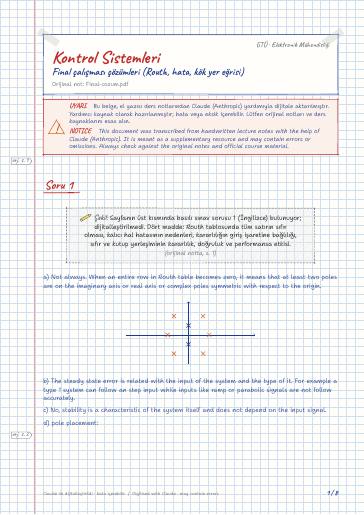
a) Not always. When an entire row in Routh table becomes zero, it means that at least two poles are on the imaginary axis or real axis or complex poles symmetric with respect to the origin.
b) The steady state error is related with the input of the system and the type of it. For example a type 1 system can follow an step input while inputs like ramp or parabolic signals are not follow accurately.
c) No, stability is a characteristic of the system itself and does not depend on the input signal.
so the second condition may not be satisfied, and for any value of k_2 the system tracks unit step input!!
in order to have no change in sign, all components of the first column must be positive which gives the following conditions
Let's check the last condition
So in total the acceptable range is 0<k<1,395
unmatched branches: n-m=3 ⇒ 3 asymptotes
The centroid of asymptotes may be determined as
Now, let's calculate the breaking points by using the characteristic equation
Now lets determine the angle of leaving from the complex pols
* leaving angle: 180^° - angles of other poles w.r.t this pole from p_3
for pole p_4 the leaving angle will be 50,75^°
We can also determine the intersection of the root locus with the imaginary axis by using the routh table as:
In order to be stable, all the above conditions must hold.
and finally all the three condition are satisfied for 38,68<k<116,31
There are two cases where we can construct a full zero row in the s^1 row
The auxiliary equation for these two cases are
so the jω crossings are
According to the current data, we can plot the root locus to a high degree of accuracy but if we