RF System Design for Communications · Digital lecture note
Lecture 11 – Dual conversion, zero-IF, sliding IF and dual-band receivers
Haberleşme için RF Sistem Tasarımı – Dual conversion, zero-IF, sliding IF ve dual band alıcılar
- Course
- RF System Design for Communications (ELM667)
- Semester
- Semester 7 · Fall 2024–25
- Format
- PDF · 14 pages · 0.6 MB · handwriting-style LaTeX
- Language
- Turkish
- Original note
- Ders-11.pdf
Open the PDF (0.6 MB)LaTeX source (.tex)Original handwritten note
What is in this note?
Section headings of the note (in Turkish):
- Dual Conversion receivers
- Disadvantages
- Advantages
- Removing Secondary Image
- Quadrature Signals & Quadrature Down conversion
- Zero-(Second) IF Heterodyne Receiver
- Sliding IF Receiver
- Dual Band Receiver
Text of the note
Show as plain text (Turkish; formulas and drawings are not included)
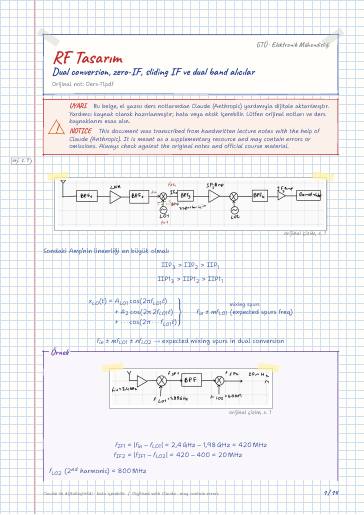
Sondaki Amp'nin lineerliği en büyük olmalı
dBc, carrier'e göre
Dual Conversion receivers
2 tane local oscillators
More mixing spurs
Several passive filters
clear choice for high sensitive radio receivers
High dynamic Range
Power consumption is lower
Secondary Image frequency
havadan sızdığı engellemek için sistem tasarımında dikkat veya sistemden ortaya çıkabilir.
Removing Secondary Image
Zero-IF (Homodyne)
eğer simetrik değilse
Quadrature Signals & Quadrature Down conversion
Positive frequency +90^° Clkwise
Zero-(Second) IF Heterodyne Receiver
Sliding IF Receiver
Both BPF and LNA reject the Image
RF bandına LO yaklaşınca image rejection zor olur
1/8 gibi bir şey kullanma image rejection zor olur
Dual Band Receiver
Çalışma sorusu 802.11a, 8 structure sliding Receiver
Mixing spurs in results of mixing with 3^rd harmonic of the first LO
& 3^rd harmonic of second LO