Analog Communication Systems · Digital lecture note
ELM 361 Recitation 3 – SSB and FM problems
Analog Haberleşme – ELM 361 Uygulama 3 – SSB ve FM soruları
- Course
- Analog Communication Systems (ELM361)
- Semester
- Semester 5 · Fall 2023–24
- Format
- PDF · 14 pages · 1.5 MB · handwriting-style LaTeX
- Language
- Turkish
- Original note
- ELM-361-Uygulama-3.pdf
Open the PDF (1.5 MB)LaTeX source (.tex)Original handwritten note
What is in this note?
Section headings of the note (in Turkish):
- ELM 361 Uygulama – 3
Text of the note
Show as plain text (Turkish; formulas and drawings are not included)
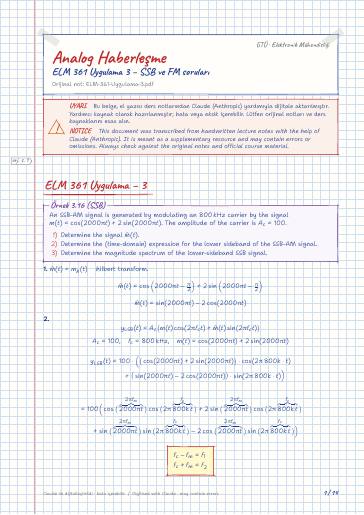
An SSB-AM signal is generated by modulating an 800 carrier by the signal m(t)=(2000π t)+2(2000π t) . The amplitude of the carrier is A_c=100 .
Determine the signal m(t) .
Determine the (time-domain) expression for the lower sideband of the SSB-AM signal.
Determine the magnitude spectrum of the lower-sideband SSB signal.
Weaver's SSB modulator is illustrated in figure P-3.17. By taking the input signal as m(t)= 2π f_m t where f_m<W demonstrate that by proper choice of f_1 and f_2 the output is an SSB signal.
input of upper LPF
input of lower LPF
→ SSB olması için seçilir.
we are choosing different f_1 and f_2 for USSB and LSSB.
We wish to transmit 60 voice-band signals by SSB (upper-sideband) modulation and freq. division multiplexing (FDM). Each of the 60 signals has a spectrum as shown figure P-3.24. Note that the voice-band signal is band limited to 3. If each signal is frequency translated separately, we require a frequency synthesizer that produces 60 carrier frequencies to perform the FDM. On the other hand, if we subdivide the channels into L groups of K subchannels each, such that LK=60 ; we may reduce the number of frequencies, from the synthesizer to L+K .
Illustrate the spectrum of the SSB signals in a group of K subchannels. Assume that a 1 guardband separates the signals in adjacent frequency subchannels and that the carrier frequencies are f_c1=10 kHz , f_c2=14 kHz – etc.
Sketch L and K such that LK=60 and L+K is a minimum.
Determine the frequencies of the carriers if the 60 FDM signals occupy the frequency band 300 – 540 kHz , and each group of K signals occupies the band 10 kHz to (10+4K) kHz .
2) we need 16 carriers with frequencies.
Eğer f_L1 grubunu 290'dan başlatırsak, subchannel'lar 300'den başlıyor olur.
The carrier c(t)=100(2π f_c t) is frequency modulated by the signal m(t)=5(20000π t) where f_c=10^8 Hz . The peak frequency deviation is 20 kHz .
Determine the amplitude and frequency of all signal components that have a power-level of at least 10% of the power of the unmodulated carrier component.
from Carson's rule, determine the approximate BW of FM signal.
1) unmodulated carrier component → c(t)
The modulation signal that is the input into an FM modulator is m(t)=10(16π t) . The output of the FM modulator is
where k_f=10 (See figure P-4.18). If the output of the FM modulator is passed through an ideal BPF centered at f_c=2000 with a bandwidth of 62 Hz , determine the power of the frequency components at the output of the filter. What percentage of the transmitter power appears at the output of the BPF?
→ Power at the output of the BPF
Power at the output of BPF is only %26.30 of transmitted power.
Effective BW → Carson Rule %99
A periodic square wave m(t) (Fig. P.5.4-2a) frequency-modulates a carrier of frequency f_c=10 kHz with Δ f=1 kHz . The carrier amplitude is A . The resulting FM signal is demodulated, as shown in Fig. P.5.4-2.b. by the method discussed in sec. 5.4 (Fig. 5.11) sketch wave forms. b, c, d, e.
A vestigial sideband modulation system is shown in figure P-3.21. The bandwidth of the message signal m(t) is W , and the transfer func. of the band pass filter is shown in the figure.
Determine h_(t) , which is the low pass equivalent of h(t) , where represents the impulse response of the band pass filter.
Derive an expression for the modulated signal y(t) .