Control Systems · Digital lecture note
Lecture 2 – Modeling, Laplace Transform & Partial Fractions
Kontrol Sistemleri – Modeling, Laplace Transform & Partial Fractions
- Course
- Control Systems (ELEC322)
- Semester
- Semester 6 · Spring 2023–24
- Format
- PDF · 8 pages · 0.1 MB · handwriting-style LaTeX
- Language
- Turkish
- Original note
- Control-Systems-lecture-2.pdf
Open the PDF (0.1 MB)LaTeX source (.tex)Original handwritten note
What is in this note?
Section headings of the note (in Turkish):
- Modeling Dynamical Systems
- Laplace Transform
- Linearity theorem
- Scaling
- Differention
- Integration
- Partial fraction expansion (PFE)
- Example
Text of the note
Show as plain text (Turkish; formulas and drawings are not included)
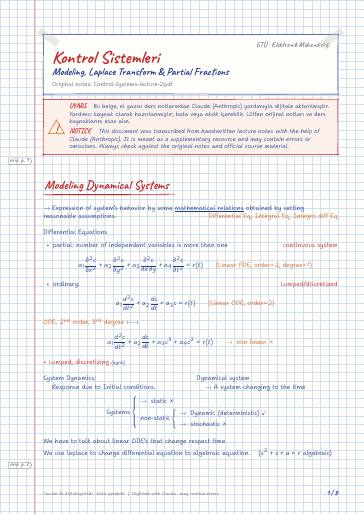
Modeling Dynamical Systems
→ Expression of system's behavior by some mathematical relations obtained by setting reasonable assumptions. Differential Eq, Integral Eq, Integro diff Eq
partial: number of independent variables is more than one continuous system
ordinary: Lumped/discretized
Lumped, discretizing (ayrık)
We have to talk about linear ODE's that change respect time
We use laplace to change differential equation to algebraic equation. ( s^2+s+a=r algebraic)
Differential theorem in laplace transform
output is y input is x
Most general ODE for a system.
Assuming that initial conditions are zero (to ignore transient respons)
Initial condition: n-1'e kadar
The max order of derivative define the output of the system
Impulse function in frequency domain
impulse response = T.F. (Transfer function)
zero initial condition
Find the D.E for the transfer function
Partial fraction expansion (PFE)
case 1: Poles are distinct and with multiplicity of unity!
tekrarlanmaz, the poles are unique, differents, not repeat
poles are = residues of the function
How to obtain the redisues.
Second method of residue calculation:
three poles of multiplicity one
case 2) Distinct poles of multiplicity k_i
Transfer function degree polynomial in the denominator: we expect n roots (poles)
make at least some potion of T.F. strictly proper (n>m)