Control Systems · Digital lecture note
Lecture 5 – State Space and 2nd Order Systems
Kontrol Sistemleri – State Space and 2nd Order Systems
- Course
- Control Systems (ELEC322)
- Semester
- Semester 6 · Spring 2023–24
- Format
- PDF · 16 pages · 0.4 MB · handwriting-style LaTeX
- Language
- Turkish
- Original note
- Control-Systems-lecture-5.pdf
Open the PDF (0.4 MB)LaTeX source (.tex)Original handwritten note
What is in this note?
Section headings of the note (in Turkish):
- State Space
- State space representation
- State space representations
- Phase variable form
- Case 1: No derivative of the input
- Case 2: Derivative of input is present
- 1st order system
- III) Ramp Response
- 2nd order response
- Underdamped Systems
- critically damped systems
- Response due to external excitation (particular solution)
- 2nd order systems
- Step response calculation
Text of the note
Show as plain text (Turkish; formulas and drawings are not included)
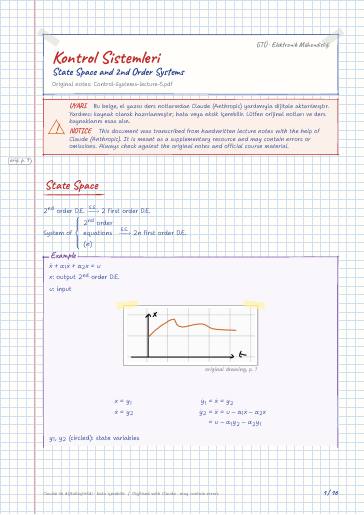
System of . S.S. 2n first order D.E.
y_1, y_2 (circled): state variables
State space representation
Fundamental operation (Mathematically) is two lower the order of D.E to half. If you are having 2n equation of 2^nd order this method produces 4n D.E. of 1^st order.
States of a system are the min number of variables to know at t=t_0 in order to describe the dynamics (response) at any later time.
State space representations
In physical variable form we just look at the energy storing elements
Phase variable form
Case 1: No derivative of the input
Case 2: Derivative of input is present
RHS → statically related (can be chosen) u : input, y : output
LHS: left hand side
RHS: right hand side
Burdan SS. formatına sokamayız
O yüzden bunu yapalım
y : output number of state variables n
ezberlemeye gerek yok, gerekirse sınavda verilir
Phase variable form
1st order system
III) Ramp Response
Accuracy is defined by `T'.
Ramp response =∫ unit response = impulse response
2nd order response
RLC in parallel
Spring mass Damper System
= zeta = damping ratio
no zeros but 2 poles are present
if <1 ⇒ complex conjugate poles (always oscillatory)
critically damped systems
(sorry) if =1 ⇒ repeated real valued poles
if >1 ⇒ seperate and real valued poles overdamped system
Homework (homogen solution)
Response due to external excitation (particular solution)
Specify the input
The response frequency for damped systems is ω_d
2nd order systems
If poles are C.C. → response is oscillatory and decaying
for ω_d=0 no oscillating frequency
at the same time
Step response calculation