Control Systems · Digital lecture note
Lecture 6 – Transient / Steady State Response (1st & 2nd order)
Kontrol Sistemleri – Transient / Steady State Response (1st & 2nd order)
- Course
- Control Systems (ELEC322)
- Semester
- Semester 6 · Spring 2023–24
- Format
- PDF · 10 pages · 0.2 MB · handwriting-style LaTeX
- Language
- Turkish
- Original note
- Control-Systems-lecture-6.pdf
Open the PDF (0.2 MB)LaTeX source (.tex)Original handwritten note
What is in this note?
Section headings of the note (in Turkish):
- Transient / Steady State Response
- First order system
- if R(s)=0 → transient solution
- First order systems
- case II) step excitation
- Impulse response =ddt (step response)
- 1st order system
- III) Ramp Response
- 2nd order response
- Underdamped systems
- critically damped systems
- Response due to external excitation (particular solution)
- 2nd order systems
- Step response calculation
Text of the note
Show as plain text (Turkish; formulas and drawings are not included)
Transient / Steady State Response
We may check the responses for 3 characteristics:
Quality of response
Accuracy of response (% error)
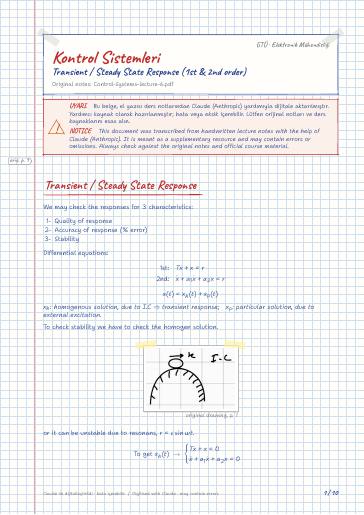
x_h : homogenous solution, due to I.C ⇒ transient response; x_p : particular solution, due to external excitation.
To check stability we have to check the homogen solution.
or it can be unstable due to resonans, r=εω t .
First order system
if R(s)=0 → transient solution
( s_1 : position of pole determines the rate of decay.)
T : time constant of the system
First order systems
Assume that there is no initial condition and R(s)≠ 0 .
case 1) impulse input: R(s)=1
case II) step excitation
derivative of response gives us the rate of change (slope of response)
only x has to be continuous
x and x has to be continuous
Impulse response =ddt (step response)
1st order system
III) Ramp Response
Accuracy is defined by `T'.
2nd order response
RLC in parallel
Spring mass Damper System
ω_n = natural frequency; = zeta = damping ratio
no zeros but 2 poles are present
if <1 ⇒ complex conjugate poles (always oscillatory)
critically damped systems
(sorry) if =1 ⇒ repeated real valued poles
if >1 ⇒ seperate and real valued poles overdamped system
Homework (homogen solution)
Response due to external excitation (particular solution)
Specifying the input
The response frequency for damped systems is ω_d
2nd order systems
If poles are CC → response is oscillatory and decaying
for × ω_d=0 no oscillating frequency; decays at the same time
Step response calculation