Control Systems · Digital lecture note
Lecture 8 – Stability, Routh Criterion, Control Actions
Kontrol Sistemleri – Stability, Routh Criterion, Control Actions
- Course
- Control Systems (ELEC322)
- Semester
- Semester 6 · Spring 2023–24
- Format
- PDF · 15 pages · 0.5 MB · handwriting-style LaTeX
- Language
- Turkish
- Original note
- Control-Systems-lecture-8.pdf
Open the PDF (0.5 MB)LaTeX source (.tex)Original handwritten note
What is in this note?
Section headings of the note (in Turkish):
- 1. Quality of response
- 2. Stability
- Routh methode
- Exception #1
- Exception #2
- Relative stability
- Method #2 for the first exception case
- Control actions
- 1) proportional action
- 2) Integral action
- 3) Derivative action
Text of the note
Show as plain text (Turkish; formulas and drawings are not included)
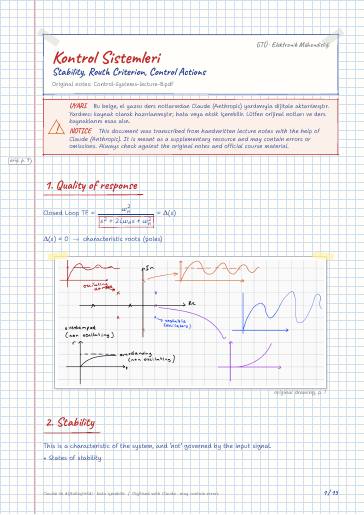
1. Quality of response
Closed Loop TF characteristic roots (poles)
This is a characteristic of the system, and `not' governed by the input signal.
States of stability
Gives a way of determining stability state without the requirement of finding the poles
- No specific pole is given but the numbers of poles on the RHP is found.
zero pole cancellation is not happening
Requirement #1: all coefficients (a_n) must be positive and nonzero!!
Requirement #2: Construct the table of Routh
Conclusion: The number changes in signs = number of poles on the RHP (look to the first column)
Pass the necessary condition
2 changes of sign: two poles on the RHP.
it can be oscilatory or not, we don't know
The value of the cell in the first column at some specific row becomes zero
just replace zero with ε>0 and move on
→ Definitely unstable because there is negative coefficient
we have got two roots on the jω axis.Claude notu: muhtemelen ``RHP'' olmalı (iki işaret değişimi var).
getting a full zero row!
1 change in sign → 1 pole: it have to be real because complex pole have conjugate
construct an auxilary equation
Solution of the auxilary eq. gives us some of the poles of the main system
case 1 of exception → at least two poles on the imaginary axis
case 2 exception → some poles are symmetric with respect to the origin
values so that all poles are in the shaded area?
all elements have to be pozitive
Method #2 for the first exception case
This change of variable gives us the reciprocal of the root
Two poles are on the RHP
Solve this:Claude notu: üsler küçük yazıldığı için okunması zor; ardışık üsler (7'den 0'a) varsayıldı.
R(s) is the input and ``can not'' affect stability and accuracy of the system
k_d e → rate of change of error
Derivative operator is always used with `P' and `I' operations
→ responsible for stability
k_p is also responsible for the location of the pole
Steady state error Final value theorem
→ responsible for error
(A pole added to the open loop function)
(responsible for sensitivity and increases stability in that sense)