Control Systems · Digital lecture note
Lecture 9 – Accuracy of Systems: Steady-State Error
Kontrol Sistemleri – Accuracy of Systems: Steady-State Error (Ders 9)
- Course
- Control Systems (ELEC322)
- Semester
- Semester 6 · Spring 2023–24
- Format
- PDF · 11 pages · 0.3 MB · handwriting-style LaTeX
- Language
- Turkish
- Original note
- Control-Systems-lecture-9.pdf
Open the PDF (0.3 MB)LaTeX source (.tex)Original handwritten note
What is in this note?
Section headings of the note (in Turkish):
- Accuracy of Systems
- Validity of final value theorem
- Steady state error for disturbance
- Sensitivity
Text of the note
Show as plain text (Turkish; formulas and drawings are not included)
Accuracy of Systems
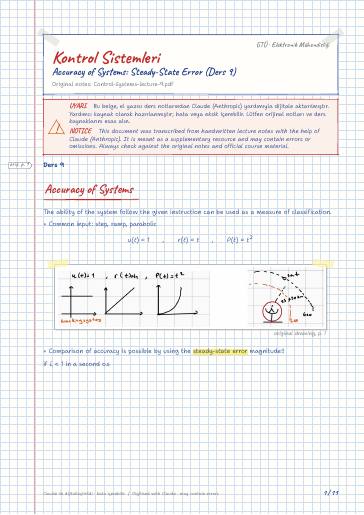
The ability of the system follow the given instruction can be used as a measure of classification.
Common input: step, ramp, parabolic
Comparison of accuracy is possible by using the steady-state error magnitude!!
Validity of final value theorem
If the poles are in zone 1 so it can't have final value
Only works with Zone III and zone IV
G(s) : open loop TF for unity feedback
In most cases the most integrator is 3
Accuracy of systems
case 2) input is ramp
But we have to check stability
k=6 is the max possible k here !!!
so max e_ss=0,33 because the system have to be stable because final value theorem is not working with unstable systems.
Steady state error for disturbance
because it is negative we can decrease error with it
Design k_1 and k_2 so that
this system order is 3 by finding characteristic equation.
The degree to which changes in the system parameters affect system T.F. and hence performance (error, stability, …) of the system
This means it's low sensitive to a
Average sensitivity : 65%200%<1 (Reduced sensitivity)
Check the sensitivity of ss. error w.r.t. parameter 'k'
for delta also