Kontrol Sistemleri · Dijital ders notu
Modeling: electrical systems, transfer function, state space
- Ders
- Kontrol Sistemleri (ELEC322)
- Dönem
- 6. Dönem · 2023–2024 Bahar
- Biçim
- PDF · 11 sayfa · 0,3 MB · el yazısı görünümlü LaTeX
- Orijinal not
- Control-Systems-lecture-4.pdf
The digital notes were created from the handwritten notes with the help of Claude (Anthropic); they are meant as a supplementary resource and may contain errors. Always rely on the original notes and the official course materials.
Bu notta neler var?
- Modeling
- Dynamical Systems
- Passive elements
- RLC circuit in series
- RLC circuit in parallel
- Methods of Complex impedences
- State space equation
Notun metni
Düz metin olarak göster (formüller ve çizimler yoktur)
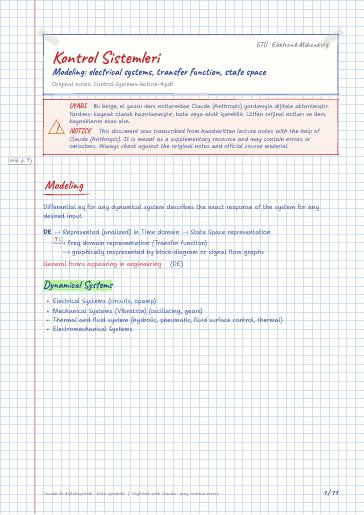
Differential eq for any dynamical system describes the exact response of the system for any desired input
DE → Represented (analized) in Time domain → State Space representation
Freq domain representation (Transfer function)
graphically respresented by block-diagram or signal flow graphs
General forms appearing in engineering (DE)
Electrical Systems (circuits, opamp)
Mechanical Systems (Vibration) (oscillating, gears)
Thermal and fluid system (hydrolic, pneumatic, fluid surface control, thermal)
[1][baseline=(iptaln.base)][inner sep=1pt](iptaln) #1 ;[line width=0.7pt](iptaln.south west)–(iptaln.north east);
The order of input is less than the output
V_o : output according to the order of derivative
→ integration in time gives the response
You have to know initial conditions
RLC circuit in series
RLC circuit in parallel
Here we have the derivative of input
Methods of Complex impedences
Impedance in Series Z_eq=Σ Z_i
There is no dynamic behavior there is
summation of impedances in mesh: (R_1+Ls)
impedance of the common element: Ls
Voltage source in mesh: V
impedance on the common element ( Ls I_1 )
State space equation
2^nd order O.E s.s. 2 first order O.E
x : output 2^nd order O.E