Kontrol Sistemleri · Dijital ders notu
Root Locus
- Ders
- Kontrol Sistemleri (ELEC322)
- Dönem
- 6. Dönem · 2023–2024 Bahar
- Biçim
- PDF · 7 sayfa · 0,2 MB · el yazısı görünümlü LaTeX
- Orijinal not
- Control-Systems-lecture-10.pdf
The digital notes were created from the handwritten notes with the help of Claude (Anthropic); they are meant as a supplementary resource and may contain errors. Always rely on the original notes and the official course materials.
Bu notta neler var?
- Root locus
- All possible root locations of a system
- Steps of Drawing
- 3- Asymptote determine
- Determine the breaking points
Notun metni
Düz metin olarak göster (formüller ve çizimler yoktur)
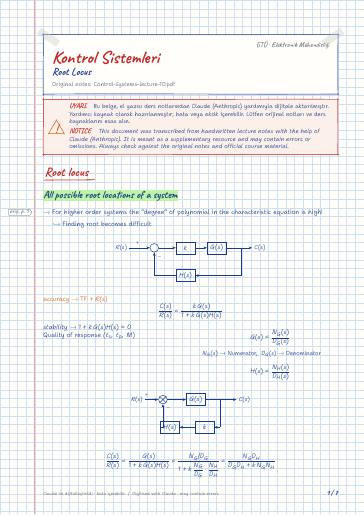
All possible root locations of a system
→ For higher order systems the ``degree'' of polynomial in the characteristic equation is high!
Finding root becomes difficult
By changing `k' roots of the characteristic equation change from `poles' to `zero' of the `open loop' T.F.
Vector representation in complex plane
origin of complex plane to s' .
F(s)=s+b for any complex s , we'll end up to as a complex number
at any s , the function value is a complex number (in general) which has a ``magnitude'' and a ``phase''
What is the function value at s=-3+j4
4 We need some criteria to check if the trial points ( s ) on the complex plane can be accepted as root of the characteristic equation
Any point like ` s ' which satisfies both conditions would be our point of interest (root of characteristic eq)
The locus of points satisfying the phase condition constitutes the root locus plot of the system.
Steps of Drawing
1- Find the OL zeros and poles and show on the s plane
2- Check the validity of point on `Re' axis
So if the number of zeros/ poles on the right hand side of the zone is `odd', then it passes the phase condition
Complex poles/zeroes not effect the acceptable zone at the real axis
if the number of poles and zeros are not the same
Then there will be some asymptotes for the root locus
poles : n ⇒ n-m : number of asymptotes
Number of Branches is equal to ` n '
Centroide of asymptotes
Determine the breaking points
Branches leave (break out) or enter (break in) the real axis at 90^°
The characteristic eq
repeated root occurs at point of break in/out ⇒ dkds=0
All break points are solution of this polynomial. But not all solutions are break in/out points
Only root of the given expression are acceptable that give a positive gain!
The other approach is that the break in/out point must be on the valid zones of the real axis.