Kontrol Sistemleri · Dijital ders notu
Root Locus (devam)
- Ders
- Kontrol Sistemleri (ELEC322)
- Dönem
- 6. Dönem · 2023–2024 Bahar
- Biçim
- PDF · 9 sayfa · 0,3 MB · el yazısı görünümlü LaTeX
- Orijinal not
- Control-Systems-lecture-11.pdf
The digital notes were created from the handwritten notes with the help of Claude (Anthropic); they are meant as a supplementary resource and may contain errors. Always rely on the original notes and the official course materials.
Bu notta neler var?
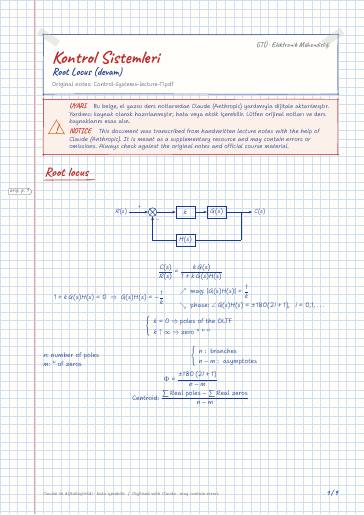
- Root locus
- 5 - Complex conjugate poles
- Step 6 Intersection with the jω axis
Notun metni
Düz metin olarak göster (formüller ve çizimler yoktur)
5 - Complex conjugate poles
Departure angle from poles?
arrival angle '' zeros
Step 6 Intersection with the jω axis
I) in the characteristic
II) characteristic eq
if one of the components of the first column is zero
make one full row zero!
So Step 7- Find the location of root locus of the complex poles!
Method I) do numerical trial & error to discover the locations of ` s ' which satisfy the phase condition
Method II) Substitute s as s=σ+jω in the characteristic equation and mathematically find the phase condition.
: magnitudes of individual complex function in numerator and denominator
for large s values
The characteristic equ.
Intersection with jω axis
checking the magnitude condition at
n = number of poles =2
break in point:
Departure angles from complex poles
for the complex conjugate pair the department angle is 145^°